



Global Parenting Guide
This guide will cover the generation of Parents, the hidden mechanics behind parenting, and general advice.
WARNING
This guide does NOT explicitly cover Independent training, because the game does not tell us how it functions, such as the odds of winning races or of finishing card chains. Additionally, at this time we lack a statistically significant data set to draw reliable conclusions.
All of the information covered in this guide can be applied to an Independent run; however, early observations indicate some key differences.
- The race win rate of an Uma with unsuitable Aptitudes (below C) appears to be significantly higher in Independent training, so try to include those races.
- SP values appear to be higher than in manual runs.
- Stats appear to be lower than in a manual run.
- Trackblazer is unsuited for Independent runs, as the Stat and SP output is extremely lacking.
- Chaining more than 3 races noticeably increases the odds of failure.
Why do parent runs?
Sparks from an Uma’s Parents and Grandparents provide Stats, Aptitudes, and Skills at the beginning of a Career and during the Inspiration Events that occur during Classic and Senior year, in early April. Better Sparks across the board make it easier to build a stronger-performing Uma in fewer runs and raise the ceiling of how strong that Uma can be. Inspiration Events depend on the Parent and Grandparent Uma's Sparks and Affinity: the Sparks determine what you can inherit, and Affinity determines how likely each one is to proc.
Types of Sparks
Blue Sparks 
- Provides one of the five base Stats and increases that Stat's Cap. Blue Sparks can influence what Decks you run: they may let you drop a Card type entirely, run fewer Cards of a given type, or spend less time on a given type of training. Blue Sparks are guaranteed at the beginning of Careers and have a very high chance of proccing during Inspiration Events.
Pink Sparks 
- Raises Style, Distance, and Surface Aptitudes at the beginning of Careers, with a chance to also raise Aptitudes during both Inspiration Events.
An Uma can only generate a Pink Spark if she has an A or above rank in the respective Style, Distance, or Surface Aptitude.
Green Sparks 
- Provides the inherited version of an Uma's Unique Skill and increases max Stat Caps based on the Parent Uma's Growths. A Parent Uma's Green Spark will always give you the inherited version of the Skill at the beginning of the Career. During Inspiration Events, it is possible to proc Green Sparks for hints of said inherited Skill from both the Parents and Grandparents, as well as a tiny increase to your Stat Cap.
Only 3★ Umas and above can generate Green Sparks. An Uma finishing her Career at 1★ or 2★ will not pass down her Unique Skill.
White Sparks
- Provides Skills or Stats depending on whether the White Spark is a Skill, Race, or Scenario Spark. White Sparks can give Skill hints that do not naturally appear in an Uma's innate kit or in the Deck currently being run. Already-obtained Skill hints will gain levels, increasing the SP cost discount up to Level 5. If a Skill is already learned, you will instead receive a small amount of Stats. White Sparks can only proc during the Classic and Senior year Inspiration Events.
Affinity & Racing
Affinity influences the chance of Sparks proccing during the Classic and Senior year Inspiration Events. There are two types of Affinity:
- Base Affinity, a fixed value that varies between any two Uma. The Base Affinity of a Grandparent cannot exceed the Base Affinity of a Parent.
- Race Affinity, which comes from shared unique G1 wins between the Parent and the Grandparents.
Winning the same race twice
Races that run in both Classic and Senior year, such as Takarazuka Kinen and Arima Kinen, only count toward Affinity once. Winning the same race in both years gives no extra Affinity.
Base Inheritance Rates, Based on Affinity
| Spark type↓ / Base chance→ | ★1 Rate | ★2 Rate | ★3 Rate |
|---|---|---|---|
| Blue Sparks | 70% | 80% | 90% |
| Pink Sparks | 2% | 3% | 5% |
| Green Sparks | 5% | 10% | 15% |
| Race Sparks | 1% | 2% | 3% |
| White & Scenario Sparks | 3% | 6% | 9% |
The above table is based on data that assumes 0 Affinity.
Affinity scales these base rates linearly, using the formula below. Each Parent and Grandparent has its own Affinity value and is rolled separately during Inspiration Events, which is why Grandparents tend to proc far less often than Parents.
Why SS Rank Matters
Affinity is a multiplier on the base rate, but the base rate itself is set by the Spark's star count.
For White, Green and Race Sparks, taking a Spark from 1★ to 2★ doubles its inheritance rate. Affinity scales the base rate by 1 + Affinity/100, so matching that same 2.00x from Affinity alone takes 100 Affinity points on that Uma, or roughly 33 shared G1 wins. Affinity is per Uma, not lineage-wide, so that cost is paid again for every Parent and Grandparent we want it from.
| Spark type | 1★ → 2★ | Multiplier | Affinity for the same gain | Shared G1 wins |
|---|---|---|---|---|
| Blue | 70% → 80% | 1.14x | +14 | ~5 |
| Pink | 2% → 3% | 1.50x | +50 | ~17 |
| Green | 5% → 10% | 2.00x | +100 | ~33 |
| Race | 1% → 2% | 2.00x | +100 | ~33 |
| White & Scenario | 3% → 6% | 2.00x | +100 | ~33 |
For those three Spark types 1★ → 2★ is also a larger jump than 2★ → 3★, which is worth 1.50x.
Rank is what moves Sparks off 1★. At SS, White and Green Sparks generate 1★/2★/3★ at 20%/70%/10%, versus 45%/50%/5% below it. 3★ gains 5 points, while 25 points move out of 1★ and 20 of them land in 2★.
On any given White Spark that is an expected inheritance chance of 4.8% below SS and 5.7% at SS, two thirds of the gain coming from escaping 1★ rather than from reaching 3★.
SS rank and Affinity stack. Rank decides what star level we are likely to generate, and thus the base rate of inheritance. Affinity scales that base rate. A run that trades away rank for a few more overlapping races is giving up the larger of the two.
For clarity, we are using "inheritance" to refer to the Spark procs that are seen during the Inspiration Events in a Career.
Check out our Roster Viewer to find your own best lineages for making Parents and Aces!
Spark Generation: How Does It Work?
Spark Generation is determined by a number of factors. While the outcome is ultimately random, a few steps can be taken to increase the odds in your favor.
Blue Sparks
Blue Sparks have an equal, fixed chance to be one of the 5 Stats, meaning Speed, Stamina, Power, Guts, and Wit each have a 20% chance.
Star count is based solely on an Uma's Stats, with 3 thresholds of note.
Blue Spark Star Odds
| Stats | 1★ | 2★ | 3★ |
|---|---|---|---|
| 1100+ | 20% | 70% | 10% |
| 600-1099 | 45% | 50% | 5% |
| 1-599 | 90% | 10% | 0% |
White and Green Sparks
White and Green Spark odds are based entirely on the Uma's rank.
White / Green Spark Star Odds
| Rank | 1★ | 2★ | 3★ |
|---|---|---|---|
| SS and above | 20% | 70% | 10% |
| G-S+ | 45% | 50% | 5% |
White Spark generation is based on the number of times a White Spark appears in a full lineage, meaning all 6 Uma that make up an Uma's Legacy: 2 Parents and 4 Grandparents. Different tiers of the same Skill will also further influence generation chances, as shown in the table below.
There is technically no limit to the number of White Sparks a Parent can have.
White Spark generation chances, based on the tier of Skill bought
| # In Lineage | White ○ | White ◎ | Gold |
|---|---|---|---|
| 0 | 20% | 25% | 40% |
| 1 | 22% | 27.50% | 44% |
| 2 | 24.2% | 30.25% | 48.4% |
| 3 | 26.62% | 33.28% | 53.24% |
| 4 | 29.28% | 36.6% | 58.56% |
| 5 | 32.21% | 40.26% | 64.42% |
| 6 | 35.43% | 44.29% | 70.86% |
The formula for calculating White Spark generation is not exactly known. The most current, supported formula is an exponential one: base chance × 1.1n, where n is the number of times the Spark appears in the lineage.
Understanding White Spark generation
- The desired Skill (or its Gold version) must be obtained on the Uma generating the Spark.
- The desired Skill appearing in your Uma's lineage as a White Spark will give better odds.
- The more times the White Spark appears in your Uma's lineage, the higher the odds of that White Spark generating.
- Gold versions of Skills give a massive increase to the odds of generating a White Spark.
It is important to note that Skills learned by the Uma in a lineage DO NOT matter at all. Having learned a Skill like  No Stopping Me! on all 6 Uma in the lineage does not grant you the ~70% odds of generating that Spark on a new Parent. If we want the full ~70% chance, we need to have the White Spark for
  Nimble Navigator appear on every Uma in the lineage we are using (6 — 2 Parents, 4 Grandparents), and then also learn the Gold version of the Skill on the Uma we are currently running.
Application
In our example below, we will assume that we have the exact same lineage on both sides for simplicity. This Parent is from URA, with two goals:
- Retain
 Uma Stan &
  Restraint
 - Acquire
 Racing Spirit: Stamina & Racing Spirit: Power
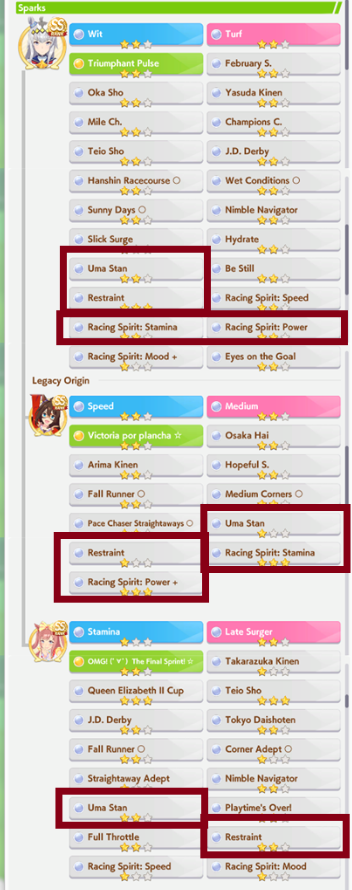
In our example:
- Uma Stan appears 3 times on each side of the lineage.
- Restraint appears 3 times on each side of the lineage.
- Racing Spirit: Stamina appears 2 times on each side of the lineage.
- Racing Spirit: Power appears 2 times on each side of the lineage.
This means we would have a total of:
6 Uma Stan = 35.43%
6 Restraint = 35.43%
4 Racing Spirit: Stamina = 29.28%
4 Racing Spirit: Power = 29.28%
Assuming all Skills obtained are White ○, our odds are:
- 0 desired Skills = 20.85%
- 1+ desired Skills = 79.15%
- 2+ desired Skills = 39%
- 3+ desired Skills = 10.20%
- 4 desired Skills = 1.08%
So what happens if we make all Skills appear 6 times?
- 0 desired Skills = 17.38%
- 1+ desired Skills = 82.62%
- 2+ desired Skills = 44.47%
- 3+ desired Skills = 13.06%
- 4 desired Skills = 1.58%
What happens when we have all Skills appear 6 times and buy a Gold version of a single Skill?
- 0 desired Skills = 7.84%
- 1+ desired Skills = 92.16%
- 2+ desired Skills = 60.17%
- 3+ desired Skills = 21.68%
- 4 desired Skills = 3.15%
Key Takeaways
- Adding new Skills is difficult and unreliable. If possible, use an Uma or Card that allows for obtaining the Gold version when trying to add a new Skill.
- Farming Parents until you have a full lineage (also known as a loop) will make creating future Parents much easier.
- Do NOT accept losing Skills on a Parent that you have no way of forcing back in, meaning Skills with no reliable source such as an Uma's innate kit, a Career event, a Card hint in your Deck, or the Scenario itself. Creating a new Parent with the Skill becomes less likely and the odds of getting the Skill from Inspiration go down. It can take up to three additional generations of Parents to fully mend a loop.
Further applications: What is Looping?
Looping is the practice of developing a lineage (also known as a loop) with little to no respect for what Blue, Pink, or Green Sparks are generated or already contained inside a lineage. Instead, looping focuses on obtaining White Sparks on a full lineage.
Is the fastest and most reliable way to add specific Skills into a lineage.
You do not need to strongly consider what Uma are being used as Parents, as the resulting lineage will almost always be used as a Grandparent, Great-Grandparent, or even further back. This frees you to pick Uma purely for the Gold Skills in their innate kit, which are the Skills you most want to seed into a loop.
Allows an Uma to obtain more desired Skills and increased Skill discounts during a Career.
Any time you have a non-desirable Pink Spark, you are adding a generation (in some cases, multiple generations) to your loop to remove it.
Has a significantly higher time investment compared to making Parents with only 1-2 Skills.
TIP
When looping, it is advisable to stay at or above the following Distance and Surface Aptitudes. While it is possible to go lower, doing so becomes Uma- and Spark-specific, at least until future Scenarios generate so many early Stats that they trivialize the Career races, even on parent Decks with limited Blue Sparks.
- Mile - B+
- Medium - A
- Long - C+
- Dirt - C+
- Turf - B+
In this example, we are going to cover the process one may take starting from zero Parents and building up to a complex loop tailored to a specific Uma.
We are going to make a loop for a  Late Surger for a generic Corner 3 Acceleration track (tracks where Mejiro Dober's inherited Unique Skill is a desirable Acceleration Skill).
Our Skills of choice are going to be: Uma Stan, Restraint, Racing Spirit: Stamina, Racing Spirit: Power, Tail Held High, Nimble Navigator, and Ramp Up
Because we have nothing at all, we want to jump-start our loop with Borrows for the hardest-to-obtain Skills. In this case, we will look for a full lineage of:
Uma Stan, Restraint, Racing Spirit: Stamina, Racing Spirit: Power
While it would be better to look for a loop with even more Skills, it is not always practical. Our first goal is to make our own lineage with all 4 of these Skills. As such, our loop will start in URA, as this is both a fast Scenario and provides two of the four Skills we want.
Because we have 0 Skills from our own Parent, we will constantly replace the non-Borrow lineage each time we add 1 more Skill to our own Parent. While Uma Stan can come from Cards or a few Uma, Restraint, at the time of writing, only comes from a Career event on Sweep Tosho, making this Skill extraordinarily hard to obtain. For this reason, we will always prioritize keeping Restraint in our loop above other Skills.
After we have our own lineage of these four Skills, we can now look to move out of URA to have a better chance at SS, as well as to add in some more Skills. Our next stop is going to be Unity, because this Scenario provides both  It's On! & No Stopping Me!, making the Sparks for them much easier to add.
At this stage, it is extremely important that we do not lose any Skill we do not have a source for, either from an Uma or in our Deck, as adding them back in will only get harder over time.
At this point, the goal is to grind out runs until both lineages are at 6/6 Skills; however, while we do this, we should also be trying to add in our remaining Skills via Card hints and/or by using Uma that have access to the Gold version of the desired Skill.
Finally, when we have either reached 7/7 Skills or are at 6/6 on both lineages, we can move on to Trackblazer, where we will aim to both fix our G1 race overlap and add in any last-minute additions that have no reasonable source aside from the random Style/Distance hints found in Trackblazer, for Skills such as Pedal to the Metal.
Recommended Race Schedules
The goal is to win as many unique G1 races as possible to maximize Affinity. Because Uma have set schedules in many Scenarios, it can be hard to maintain perfect overlap. For this reason, any Scenario that either removes required races or locks all Uma into the same schedule will have an advantage.
These schedules are built to run the less consistent races during Senior year. Doing this allows your Trainee to have more Stats and Skills, which should make these races more favorable. Importantly for Trackblazer: Japan Cup is run in Senior year and Mile Championship is run in Classic year, for Scenario Epithet reasons.
- Early Dec Hanshin Juvenile Fillies & Asahi Hai Futurity Stakes
For this example, we resolve it by choosing Hanshin Juvenile Fillies, because Tiara Uma must run this race in Trackblazer, and we want to maintain maximum Affinity between Parents.
- Late Dec Hopeful Stakes & Zen-Nippon Junior Yushun
- Early May Victoria Mile & Kashiwa Kinen
For these two examples, we resolve it by prioritizing the race that the majority of Uma will have natural Aptitude for, while also considering what is a more common forced race. In this case, we will run: Hopeful Stakes & Victoria Mile
- Early Nov Queen Elizabeth II Cup & JBC Classic & JBC Ladies’ Classic & JBC Sprint
For this turn, we get to run two of the four races. The priority is still Turf races, so the first race is Queen Elizabeth II Cup. For the second race, we default to what the majority of Uma can naturally run, which is JBC Classic. This race can appear as either a Mile or Medium; regardless of which Distance you run, so long as it is the same G1 you will get credit toward your Affinity from overlapping races.
- While the conflicting Tiara and Crown races also fall into this category, we resolve all of them by following the logic: if one Tiara race is run, the other two are run as well. The same is true of Crown.
INFO
A Parent's Aptitude can be raised to B to enable them to run Mile races without generating a Mile Pink Spark. However, winning Mile races in a Career tends to be much less consistent without Mile A.
To Dirt or Not to Dirt?
| G1 Races Tiara | Turf | Dirt | G1 Races Crown | Turf | Dirt |
|---|---|---|---|---|---|
| Sprint* | 1 | 0 | Sprint* | 1 | 0 |
| Mile | 6 | 3 | Mile | 5 | 3 |
| Medium | 9 | 5 | Medium | 8 | 5 |
| Long | 2 | 0 | Long | 3 | 0 |
* Only with natural Sprint Aptitude. All other Sprints are on turns where we already have Medium races.
By following the standard Tiara and Crown schedules, we can see that an Uma will actually end up running more Dirt races than Longs by a wide margin, 3 Long : 8 Dirt. When we run a Tiara schedule that is unable to do Long races, we end up losing 6 Affinity individually, up to a maximum of 24. Compare this to losing our Mile and Medium Dirt G1 races — 8 in total, for 24 Affinity individually or up to a maximum of 96. The clear path forward is to abandon Longs in favor of adding in Dirt races.
Do you NEED to add Dirt races, and if so, when?
Objectively, it is better to add in Dirt G1 races due to the large Affinity boost; however, setting up a Dirt rotation can be very time-intensive.
Because we do not want to hamper the odds of inheriting the desired Pink Sparks on Ace Uma, we need the Dirt Sparks for our Parents to effectively fall off when a direct Parent is generated.
What this means is that at our Great-Grandparent (GGP) layer, we need 10+ Dirt Sparks on the direct Parents, e.g. 3+2, 3+2 = 10 Dirt. This means we only need to provide a single Uma with a 2-star Dirt Pink, as we can always borrow a 3-star Dirt Parent. Additionally, it is not strictly necessary for our GGP to actually be able to run Dirt races, as they will not come into our Affinity calculation for our Ace Uma. Remember, Affinity matches Parent to Grandparent (GP), not beyond.
Conclusion
- Currently, it is advised not to worry too much about Dirt G1 races.
- In the long term, aim to add Dirt races wherever possible.
While it is absolutely worth adding in Dirt races, it is something that can be worked on long term. While it is beneficial to have higher Affinity during parent runs for increased chances at inheriting Skills, it is not strictly needed. Compared to the old Affinity system, you will still have more Affinity running a strictly Turf schedule than a pre-July 1st patch schedule with 45 unique overlapping races.
In the future, there will be a Spark locking feature that will allow for the selection of a Pink Spark. It is generally recommended to wait until this update before starting to incorporate a Dirt rotation.
How do we add in Dirt races?
- At Dirt G, we would need a total of 10 Dirt Sparks to force an Uma to Dirt C.
- At Dirt C, races become winnable on a consistent basis.
TIP
Long races in Career can be run comfortably with Long C. Dirt races in Career can be run at Dirt C, and even Dirt D in some cases. This varies between Uma.
Having low Long and Dirt Aptitudes is viable primarily because Long and Dirt G1s start from the middle of Classic year. We can further alleviate this by running almost all of our Dirt races in Senior year, as only one Dirt race must be run in Classic year. By the time you encounter these races, you should have enough raw Stats to push through them.
General Skill Priority for Parents
WARNING
These are broad, generalized Skill recommendations. Consider what content you are training your Uma for, and that Uma's innate kit. Think of this more as a starting point to form your own opinions and plans going forward.
All Running Styles have a simplified section recommending 4 Skills that will be impactful but not extremely hard to obtain. For the long term, all Running Styles should strive to add more Skills than what is listed.
Special Mentions
- TS Climax (Scenario Spark from Trackblazer, provides
 Stamina &
  Guts).
 - Corner and Straight Skills (Scenarios going forward do not naturally grant these Skills, unlike Trackblazer).
- Any late-race Speed Skills.
- Green Skills.
Simplified loop
- Groundwork,
 Ignited Spirit WIT,
  Prudent Positioning, Dodging Danger
Long-Term Goal
- Groundwork
- Ignited Spirit WIT
- Racing Spirit: Stamina
- Prudent Positioning
- Dodging Danger
- Tail Held High
- Firm Resolve
- Straight and Corner Skills
Simplified loop
- Groundwork, Nimble Navigator, Racing Spirit: Stamina, Uma Stan
Long-Term Goal
- Groundwork
- Nimble Navigator
- Racing Spirit: Stamina
- Racing Spirit: Power
- Uma Stan
- Tail Held High
- Shrewd Step
- Straight and Corner Skills
Simplified loop
- Uma Stan, Pedal to the Metal, Tail Held High, Nimble Navigator
OR
- Uma Stan, Racing Spirit: Stamina, Pedal to the Metal, Nimble Navigator
Long-Term Goal
- Uma Stan
- Restraint
- Racing Spirit: Stamina
- Pedal to the Metal
- Racing Spirit: Power
- Tail Held High
- Nimble Navigator
- Straight and Corner Skills
Simplified loop
- Uma Stan, Restraint, Tail Held High, Nimble Navigator
OR
- Uma Stan, Racing Spirit: Stamina, Tail Held High, Nimble Navigator
Long-Term Goal
- Uma Stan
- Restraint
- Racing Spirit: Stamina
- Racing Spirit: Power
- Tail Held High
- Nimble Navigator
- Straight and Corner Skills
Where to start?
General strategies
There are a few approaches to parenting that all scale with time investment.
Goals
Create a serviceable Parent that gets the job done. We do not have a big focus on White Sparks or Affinity here.
It does not matter as much what Sparks exist on its Grandparents, as they naturally get culled from the lineage.
- Reuse Ace Runs as Parents & Grandparents
- Find any Uma that you have previously made, including Aces, Team Trials Uma, or any miscellaneous runs you have done. Be sure to consider relevant Pink Sparks, desired Blue Sparks, and some desired White Sparks.
- Find a Borrow that at the bare minimum has the correct Blue, Pink, and some desired White Sparks on the main Parent.
- Complete runs until you are happy with the resulting output, e.g. a desired Blue or Pink Spark with any needed Skills, or even just the correct Blue and Pink Sparks.
Pros
- Requires minimal effort; every output has a chance at finishing your desired Parent.
- Simple and easy to understand.
Cons
- Ace Careers tend not to run all available G1 races; as such, Affinity will heavily suffer.
- An Ace may not have a Unique Skill that is desirable as an inherited Skill.
- If you commonly run the same Uma, then you are sacrificing a potential inheritance slot on your Legacy.
Goals
Create a lineage with desirable Unique Skills, Blue, Pink, and 2-4 desired White Sparks.
- Dedicated Parent Career
- Pick any Uma with a desirable inherited Unique Skill.
- Find a Borrow with as many G1 races won as possible, as well as relevant Blue, Pink, and White Sparks.
- Complete runs until this produces a Parent with acceptable Sparks for a GP.
- Take the new Parent you have made and match it with a Borrow that you want as a GP.
- Repeat until you make an Uma that you are happy with as one of your main Parents.
- At this point, you have now made half of your total lineage. You can now take that Parent and reuse it as a GP for the other side of the lineage.
Goals
Create loops with hard-to-obtain and impactful Skills, and set up our own Dirt GGP layers of Parents. At this stage, Borrows are mainly used either as a Parent on Ace runs when you do not own a specific Uma and you need their Unique Skill, OR to progress any loops you have set up / are working on.
- At this level, it is assumed you already understand how and why you are making a loop and the resulting Parents.
Pros
- Provides vastly more Skills and hints than other Trainers have access to.
- Allows you to rapidly make Parents out of new releases, as you already have all the prerequisites done.
Cons
- Time- and RNG-intensive.
- Relies on you having a lot of different Uma that you may not have otherwise pulled, just so you can make Parents/GP/GGP with them.
- Starting time investment is very high.
- Every time you need to add new Skills into your loop, you must create a whole new layer of GGP.
Goals
Reach maximum Affinity on all Parents and remove all dependency on Borrows; create and maintain complex loops including various Distances, Surfaces, and Skills.
At this level, it is assumed you have already passed the High Time Investment goals and have a deep understanding of parenting.
Dirt Rotation The future meta for parenting for the rest of the game's lifespan is to run Dirt G1s to maximize the number of overlapping G1s. As such, we will exclusively be making our Parents to include these races.
Pros
- Do not need to rely on other players' Borrows.
- Will yield the best Parents you can make.
Cons
- Extremely time-intensive.
- It is possible that by the time the content you are making Parents for is released, you have not hit your goal due to RNG.
- If you do not enjoy doing the same Uma Career many times, you may get burned out.
- If you do not have a decently deep pool of owned Uma, this becomes either impossible or will lead to increased time investment.
Scenario Overviews

 Speed
Speed Stamina
 Power
Power Guts
Guts Wit
WitAfter the rework, this Scenario has reasonably high and balanced Stat Caps; however, it does not have any mechanics to actually elevate more than one or maybe two Stats near the new Caps. Combined with the lower SP values, getting SS is very hard, making this Scenario suboptimal for making final Parents and Grandparents.
Acquire 1-5 of the Unique URA Skills on all Uma in 1 lineage if using Borrows, or in 2 lineages if not using Borrows, so that you may carry Sparks only found in URA into other Scenarios.
If your current loop has hard-to-acquire Skills such as
Restraint, it is advisable to also retain these Skill(s) before leaving URA.Get out of URA.
- Very fast Scenario, 13-20 min.
- Powerful Skills that are exclusive to URA.
- No complex mechanics, making this an easy starting point for a lineage.
- This Scenario generates between 2.4k and 3.2k SP.
Skills from Duels with Happy Meek:
Racing Spirit: Speed
Racing Spirit: Stamina
Racing Spirit: Power
 Racing Spirit: Guts
Racing Spirit: Wit
 Racing Spirit: Mood
- Acquire the URA-exclusive Skills as White Sparks that are relevant to your Running Style.
Racing Spirit: Stamina
Racing Spirit: Speed
Racing Spirit: Wit
Racing Spirit: Mood
Racing Spirit: Stamina
Racing Spirit: Power
Racing Spirit: Speed
Racing Spirit: Wit
Racing Spirit: Mood
- Racing Spirit: Stamina
- Racing Spirit: Power, Racing Spirit: Speed, Racing Spirit: Wit
- Racing Spirit: Mood
For a more detailed overview of the updated URA, check out our Updated URA Guide.
 SpeedStaminaPowerGutsWit
- Has 5 unique Scenario Skills that can be inherited as White Sparks.
- Provides a large amount of Skill hints, as the Unity mechanics make Card hints more consistent compared to other Scenarios.
- Provides the generally good Skills It's On! & No Stopping Me! for free from interacting with the Scenario mechanic, allowing Trainers to easily inject two powerful Skills into a lineage without taking up valuable Card slots.
- Allows for additional races without punishing overall Stat and SP gain.
- Grants 2.7k - 3.3k SP on parent runs.
On release of the updated Unity Cup, this Scenario provides the best overall Stat gain from its mechanics, while also providing a suite of valuable Skills, including some Unique ones.
- Due to almost every Parent for Front Runners having access to the same schedule, Trainers can consider making Unity their default spot for making Front Runner Parents until L'Arc releases.
- Because one of Front Runners' most desired Skills to keep in a lineage is Ignited Spirit WIT, a Skill that is both native and guaranteed from Unity, Trainers do not need to feel pressured to maintain this Skill in every part of a lineage. While it is always better to have a full Legacy with the same Skill Sparks, having an easy way to reintroduce the Skill from
 Burning Spirit WIT means that Trainers will have a substantially easier time building up strong Parents in Unity, while also maintaining any other Scenario-specific Skills.
Trainers have three options for how to use Unity:
- Make Parents exclusively inside of Unity
- Add valuable Sparks to an already existing loop, such as Nimble Navigator, Ramp Up, etc., and then move on to other Scenarios.
- If a Trainer is just starting out with Parents, they can start an effective loop from nothing in Unity, as it can provide 2 Gold Skills innately regardless of the Running Style, which makes generating a 3- or 4-Skill loop very easy.
Race Bonus is still very important in this Scenario, as it scales the rewards from both races and Unity matches that occur throughout the Career.
 SpeedStaminaPowerGutsWit
- No mandatory races, allowing for maximum Affinity.
- Consistent SS-rank Legacies.
- 2.7k - 3.2k SP.
- Longest average Career in the game, 35 - 40 min.
- No long-term Skills unique to Trackblazer.
- Yields a large amount of random Skill hints for the Style your Uma won a race in.
- Allows you to use Alarm Clocks on any race — up to 5 per Career, making it much more consistent.
- Line up all G1 races in a lineage.
- TS Climax Spark for Stamina & Guts.
- Some of the most impactful inherits, such as
 Moving Past, and Beyond & Budding Blossom, are effectively locked into running the Tiara route, because Mejiro Dober and Nishino Flower are unable to simultaneously run Long and Dirt tracks. This means you will need to adjust the rest of your Parents to better line up with it.
 - By moving to Tiara, we remove Kikuka Sho from our race rotation, significantly lowering the Stat pressure and increasing our G1 success rate.
- On average, allows more Uma to match 100% of our race rotation than introducing a third Long G1 would.
- Because the vast majority of Front Runners have at least Long C, staying on Crown rotation means Parents will be better when you need to transition out of Trackblazer to later Scenarios, and it allows you to farm current Parents in other Scenarios.
Trackblazer will be the go-to final stop for min-maxing Parents due to increased Affinity, and will only get power-crept after Grand Concert.
 SpeedStaminaPowerGutsWit
- A training-focused Scenario, which makes running all G1 races while also hitting desired SP and Stats extremely challenging.
- Unity and Trackblazer are significantly better for Parents.
- 2.5k - 3.2k SP.
- If using Independent Training, this is a good scenario to try to hit SS rank in, to increase the chance of higher star ratings on your white sparks
Finding cards for your deck
Parent Decks do not need to be good Decks in the usual sense. A Deck for a Career run is built to maximize Stats; a Deck for a Parent run is built to maximize what gets passed down. Those are different jobs, and a Deck that is mediocre at the former can be excellent at the latter.
A Parent Deck only needs to balance three things:
- Hit SS rank. Higher rank means a higher chance of higher star ratings on your White Sparks, which is the whole point of the run.
- Generate enough SP. You cannot buy the Skills you want to pass down if you cannot afford them. See each Scenario's SP target in Scenario Overviews.
- Carry the Skills you want to loop, preferably as the Gold version. What loops is the White Spark, not the Skill itself, but learning the Gold version on the Uma you are running massively increases the odds of generating that White Spark. Since forcing a Skill back into a lineage later is the hardest part of maintaining a loop, take every source of the Gold version you can get.
The third point is the one people get wrong. It is tempting to pick the six strongest Cards you own and hope the Skills work out. Instead, start from the Skills, then find the Cards.
Working backwards from the Skills
Pick your target Skills first, using the General Skill Priority for Parents lists above as a starting point. Then use the Skills page to find every source for them.
1. Find and pin your target Skills
Search for each Skill you want in your loop and pin it using the pin icon on the Skill card.
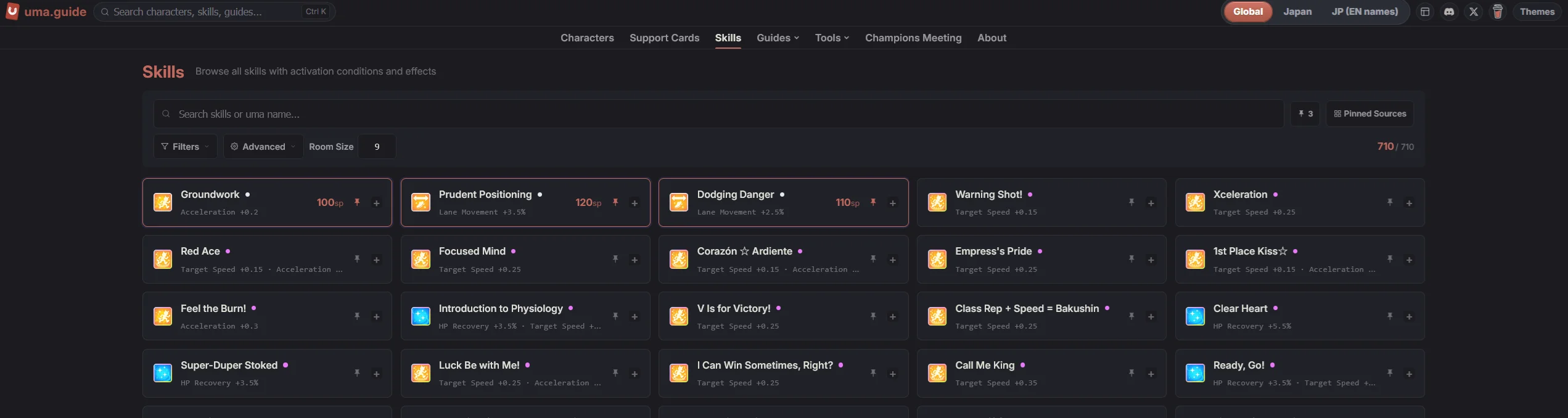
Pin each Skill you want to loop using the pin icon on its card.
2. Open Pinned Sources to see which Cards provide them
Press Pinned Sources. This lists every Support Card that can grant your pinned Skills, along with how it grants them.
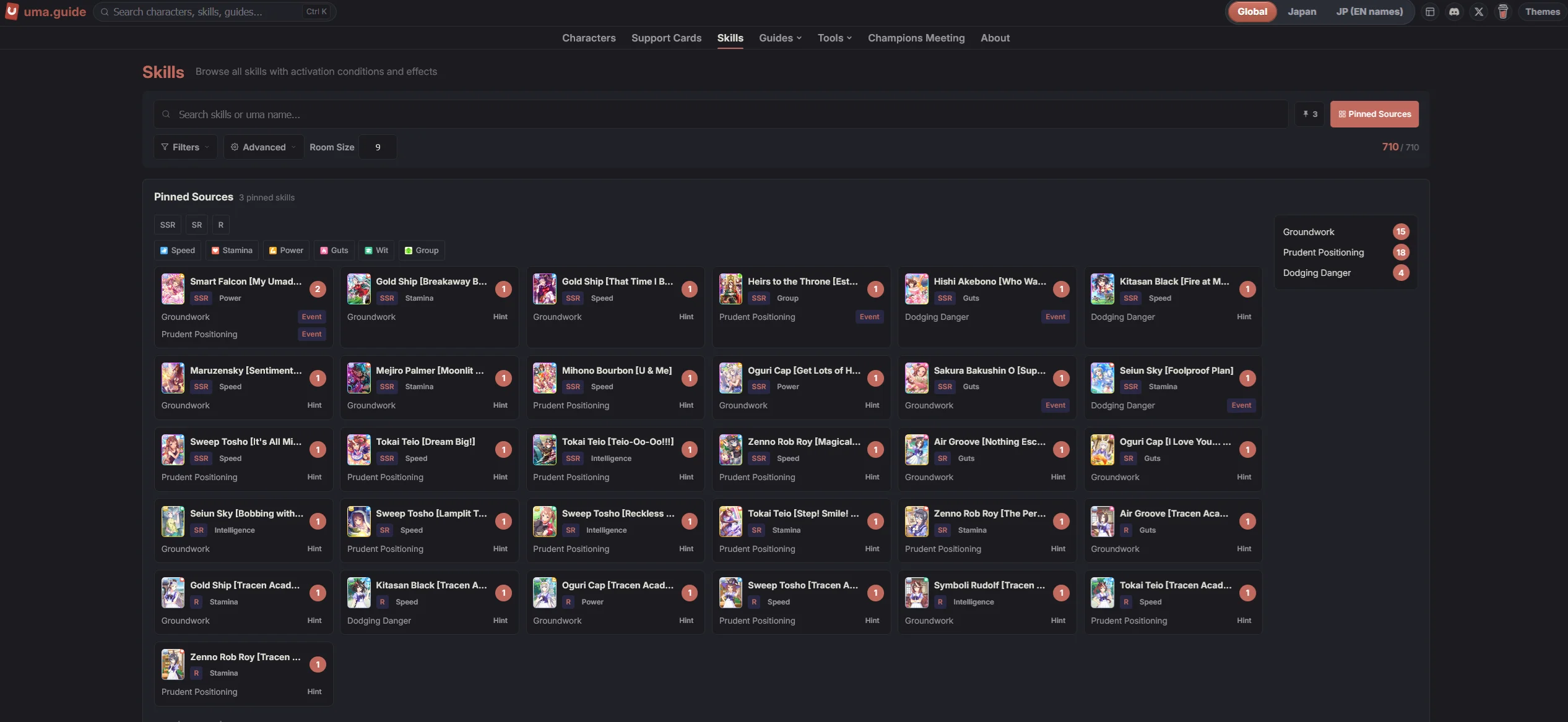
Pinned Sources lists every Support Card that can grant the pinned Skills, tagged Hint or Event.
Two details matter here:
- The Hint or Event tag tells you how you get the Skill. A Hint means the Card can roll the Skill as a training hint, discounting it and making it available for purchase. An Event means it comes from a Card event, which is more reliable but usually gated behind a choice or a specific timing.
- The number badge on a Card is how many of your pinned Skills that Card covers. A Card covering two or three of your targets is worth far more to a Parent Deck than a statistically stronger Card covering none.
You can filter by rarity (SSR / SR / R) and by type using the chips at the top.
3. Check the Uma section for base kit Skills
Scroll further down and you will find Umas that have your pinned Skills in their base kit.

Umamusume carrying pinned Skills in their base kit, listed separately from Support Cards.
This is the most reliable source of all. A Skill in an Uma's innate kit costs you no Deck slot and cannot fail to appear. When you are choosing which Uma to run for a Parent, this list should drive that choice, since when looping the Uma itself barely matters beyond the Skills it brings.
Putting the Deck together
Build the Deck in this order:
- Pick the Uma for the Gold Skills in their base kit.
- Add Cards that cover the remaining target Skills, prioritizing Cards that cover more than one and Cards that grant the Gold version.
- Fill the remaining slots with whatever gets you to SS rank and your SP target.
Step 3 is the one you compromise on. If you have to choose between a stronger Card and a Card that carries a Skill you have no other source for, take the Skill. Stats can be made up elsewhere; a Skill with no source in your Deck is one you may never get back into the lineage.
TIP
Re-check your Deck whenever your loop advances. Once a Skill is stable in your lineage, the Card that was seeding it can be swapped out for one covering the next Skill you want to add.